Enhancing Material Development and Manufacturing Technologies of Lightweight Alloys and Tribological Performances for Unmanned Aerial Systems Development
U.S. Army Research Laboratory
Summary
Northwestern researchers are advancing next-generation propulsion technologies for unmanned aircraft systems by developing innovative materials and manufacturing solutions that improve performance, reliability, and efficiency under demanding operating conditions. Supported by a $3 million U.S. Army Research Laboratory award, the interdisciplinary team combines expertise in materials science, tribology, computational mechanics, and advanced manufacturing to address critical challenges in fuel-system durability and lightweight propulsion components.
Using the technology of Directed Energy Deposition, a 3D object is created by depositing powder directly into a small molten pool generated by a laser beam to create solid material layer-by-layer. The unique thermal conditions created by this process allow for the manufacture of alloys not realizable by conventional manufacturing methods, such as casting. This method is used to create reliable lightweight advanced materials with tailored mechanical properties by actively controlling the thermal history of a component during the build process. This work has developed a patent pending thermal control system to bound the thermal gradient of the AM build within a desired range. Preliminary results using this system show that tensile strength in the final part can be controlled by varying the solidification and cooling rates during the build.
The project focuses on two key areas: reducing friction and wear in high-pressure fuel pumps to improve system reliability and creating high-temperature aluminum alloys and additive manufacturing processes that enable lighter, more resilient propulsion systems. By integrating computational materials design, advanced coatings, and hybrid manufacturing methods, the researchers aim to develop propulsion technologies that can operate more efficiently across diverse fuels and environments. The work is conducted in partnership with industry collaborators Valvoline (surface engineering), ECK Industries (casting), NanoAl (alloy development), and DMG-MORI (additive manufacturing), for furthering commercialization, accelerating translation from fundamental research to real-world implementation.
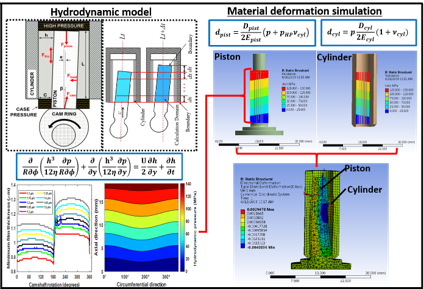
Modeling and Simulations of Army Fuel Pump Parts for Failure Analysis and Design Optimization
Achievement Highlights
- Generated 40+ journal articles & 1 book, along with 5 Patent applications
- Project supported over 3 Undergraduate Student, 8 PhD students, and 7 Postdocs
People
Jian Cao
Yip-Wah Chung
David Dunand
Greg Wagner
Jane Wang